Our Impact
Every piece of data we collect represents a deep and complex human being on a journey of self-discovery and transformation.
Quantitative Data
We collect this data through self-reported surveys completed by participants periodically throughout LUME engagements. These surveys contain a combination of measures from research literature as well as homegrown tools that LUME studies continuously to ensure they are effective at capturing the essence of the constructs we aim to measure with them.
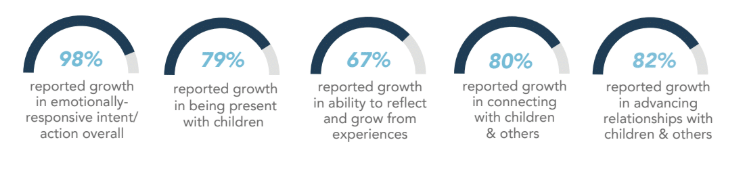
Since 2020, LUME has engaged 350+ educators at nine institutions in “LUME Approach” learning experiences. Among educators in those engagements¹:
¹Reflects statistically significant findings from participants who provided both pre and post reflection data
Qualitative Data
Measures with Statistically Significant Change
Being present with children
Ability to reflect and grow from experiences
Connecting with children & others
Advancing relationships with children & others
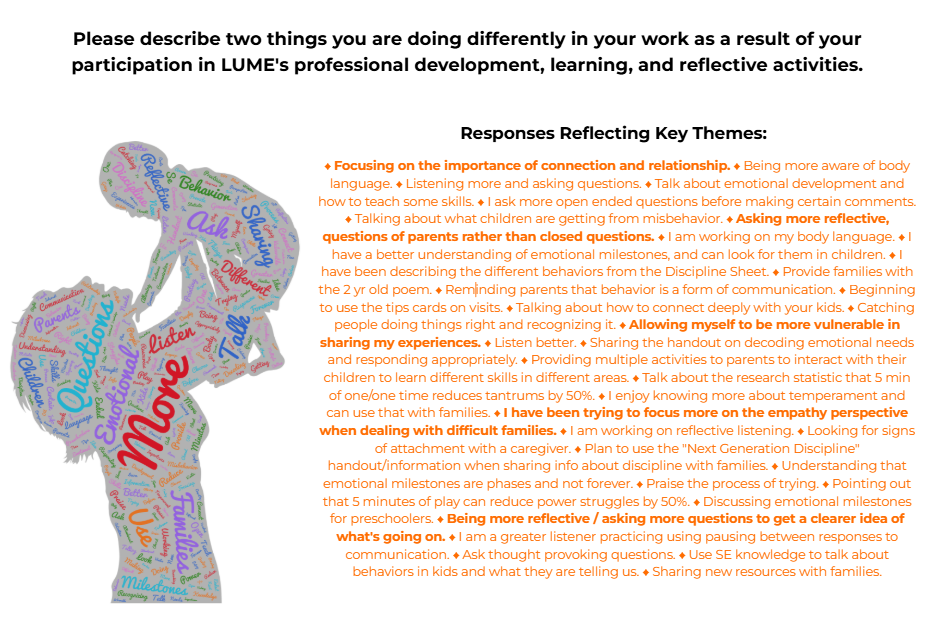
While numbers are necessary, they are not sufficient to capture the rich and nuanced ways that individuals and organizations grow and develop in partnership with LUME. Qualitative data provides context, elevating participant voices to tell their own stories of change. We collect this data primarily through open-ended questions in surveys taken by participants periodically throughout LUME engagements.
Why Data Matters
As a learning organization that practices what we teach, we are deeply intentional about our program evaluation process, ensuring all data serves the purpose of both reflection and research.
-
Connecting with organizations periodically throughout LUME Engagements to co-reflect on how their organization is transforming and what they need from us to continue making progress toward their goals for growth and development.
-
Ongoing reflection as a team to understand how our work is supporting participant transformation and to identify opportunities for growth in our curriculum and pedagogy.
-
Thanks to initial guidance and technical support from the Center on the Developing Child at Harvard University, funding from Missouri Foundation for Health, and ongoing partnership with the University of Missouri St. Louis, we have spent the past seven years building and refining a flexible yet rigorous approach to evaluation research that attunes to the complex and dynamic nature of the organizations we partner with as well the systems they operate in.
Research Partnerships
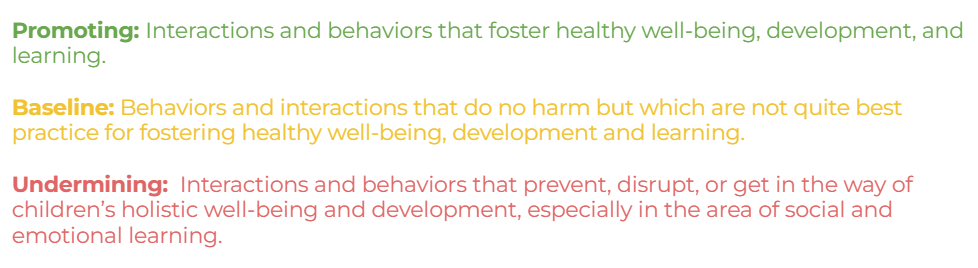
Through LUME’s multi-year research partnership with the University of Missouri St. Louis that began in 2021, an independent observer has assessed classrooms at University City Children’s Center (UCCC) and two additional LUME partner centers using the Climate of Healthy Interactions for Learning and Development (CHILD) Tool from Yale University’s Child Study Center, which is one observational assessment for understanding Classroom Climate that is recommended by the Center of Excellence for Infant and Early Childhood Mental Health Consultation at Georgetown University.

Educational organizations engaged in ongoing partnership with LUME show observational evidence of interactions and behaviors that Promote healthy well-being and emotional and social development for children.